
Kan L, Etschmann B, Rae N, Reith F, Ryan CG, Kirkham R, Howard D, Rosa DRN, Zammit C, Pring A, Ngothai Y, Hooker A, Brugger J (2016, accepted 21.9.15) Ore Petrography Using Megapixel X-Ray Imaging: Rapid Insights into Element Distribution and Mobilization in Complex Pt and U-Ge-Cu Ores. Economic Geology, vol. 111 no. 2 487-501; 10.2113/econgeo.111.2.487
2015 Future Fellowship Announcement in Brisbane
Brisbane
On the 16th of December 2015 Senator the Hon Simon Birmingham (Minister for Education and Training, Senator for South Australia) congratulated the Future Fellows and said, the Future Fellows will help the nation innovate, invent and apply new ideas across key research areas, forming part of the Turnbull Government´s Innovation Agenda.
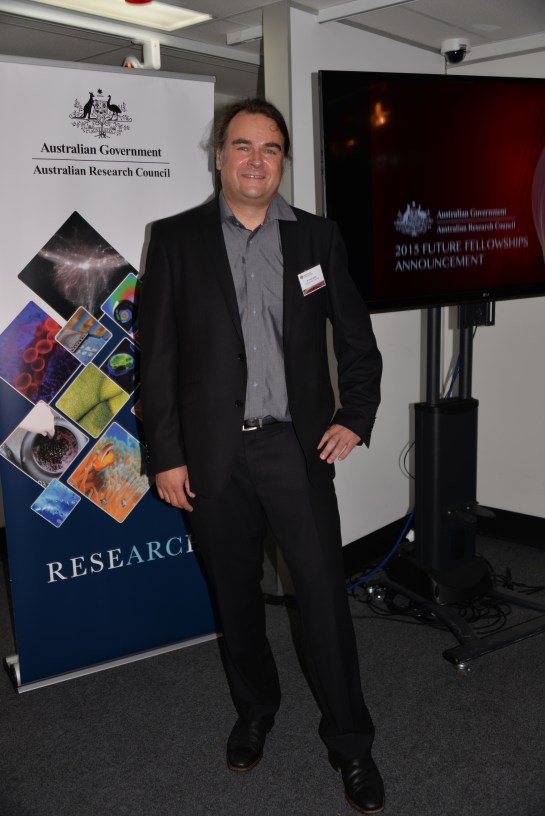
Fifty new research projects can get underway immediately, the Turnbull Government announced today (16/12/2015), as part of 38.6 million worth of funding through the Australian Research Council.
One of these research projects is yours- Dr. Frank Reith! Congratulations!
Future Fellowship Announcements
Congratulations Dr. Frank Reith for receiving the ARC Future Fellowship!
AUSTRALIAN RESEARCH COUNCIL
Future Fellow: Dr. Frank Reith
Project: Geobiological gold cycling: golden opportunities for the minerals industry
This ARC Future Fellowship in geomicrobiology is ultimately aimed at creating the research concentration focussing on the development of innovative strategies for geobiological exploration and bio-processing, which are rooted in the deep understanding of the global geobiological gold cycling.
Summary
This fellowship aims to develop new geobiological tools for gold exploration and processing that are rooted in the fundamental understanding of global, geobiological gold cycling. Australia, as a world-leading gold exporter, strongly relies on innovative approaches to enhance its mining excellence. Yet, many gaps in our fundamental understanding of bio(geo)chemical gold dispersion and precipitation remain. This project aims fill these gaps by linking biochemical pathways of gold mobilisation and resistance in bacteria to its transport and biomineralisation. This will enable the development of protein-based biosensors, bioindicators and nano-vectors for exploration and bioaccumulation technologies to enhance production from sub-economic ore.
Impact
Given the high production costs, the sustainability of the Australian gold industry relies strongly on innovation. This fellowship aims to provide the biomolecular understanding of the geobiological processes driving the gold cycle. This will result in development of biotechnologies allowing more economically sustainable and environmentally viable mining practices, hence affirming Australia’s leadership role in gold exploration and processing.
Research questions and applications:
Question 1: Are mobile gold(I/III)-complexes and suspended nanoparticles equally important as vectors of gold transport around buried deposits?
Application 1: Ultrasensitive analytical methods for gold exploration.
Question 2: Can soil microbial communities indicate underlying gold deposits?
Application 2: Bioindicator arrays for exploration.
Question 3: Which biochemical pathway does gold detoxification/resistance and biomineralisation follow in Cupriavidus metallidurans?
Application 3: Field-based biosensor for quantification of gold in exploration samples.
Question 4: Do gold grains form in Earth surface environments?
Application 4: Bio-processing technology for sub-economic materials.
Save Radio Adelaide!
Please sign the petition to save RADIO ADELAIDE.
Klick on the link:
Thank you so much!
“What`s new in Australian Minerals”
We are currently joining the 38th Annual Seminar of the
“Joint Mineralogical Societies of Australasia”
in Launceston (Grindelwald) in Tasmania,
proudly hosted by “The Mineralogical Society of Tasmania Inc”.
Thank you, Ralph Bottrill, for inviting me as a guest speaker.
Thank you, Marnie Pope, for organizing this interesting trip!
A great opportunity to meet people from all over the world (e.g. Canada, USA, England, Australia etc.)!
I hope you will enjoy my talk:
“Supergene transformation of Tasmanian ‘osmiridium’ nuggets. The role of biofilms”.
Let´s keep in contact!
Yours,
Dr. Frank Reith
Germany 2015
Europe 2015 – a fieldtrip to Norway, Sweden and Finland
It was an overwhelming trip to Europe again (June- September 2015)!
We caught some of the wonderful moments with colleagues and friends on camera. Please check out the pics on Pictures from Norway, Sweden and Finland in our photogallery “In the field”.
Thanks to all collaborators, friends and their families in Europe for their kindness, hospitality and ideas!
New PhD and MSc projects available!
Please check out the latest news about our PhD and MSc projects here:
New papers!
Check out the newest papers!
Effect of manganese oxide minerals and complexes on gold mobilization and speciation
C Ta, J Brugger, A Pring, RK Hocking, CE Lenehan, F Reith
Chemical Geology 407, 10-20
2015
Surface transformations of platinum grains from Fifield, New South Wales, Australia
SG Campbell, F Reith, B Etschmann, J Brugger, G Martinez-Criado, …
American Mineralogist 100 (5-6), 1236-1243
2015
Pleistocene paleodrainage and placer gold redistribution, western Southland, New Zealand
D Craw, G Kerr, F Reith, D Falconer
New Zealand Journal of Geology and Geophysics, 1-17
Successful in Gympie!
Great success in growing gold!
Read the article in the Gympie Times about our latest work trip! Click on this link!
We hoped to see bigger pieces of gold – and we found it! Thanks to all colleagues, who support(ed) this project!
A special thank goes to John Parsons (Prophet Mine in Kilkivan) and his family for supporting us during all those years of collaboration!
 The man with the gold bug